



Most server room air conditioning failures are not capacity failures. They are measurement failures. ASHRAE Technical Committee 9.9 sets the recommended envelope, 18°C to 27°C, at the IT equipment air intake rather than at a wall thermostat or CRAC return grille. Control server room air conditioning on return-air temperature and the panel can show a comfortable 22°C while top-of-rack and row-end inlets sit outside the envelope.
The fix is rarely more tonnage. It is moving the control point to the rack inlet, then re-tuning setpoints and airflow against that reading. This article works through one narrow problem: how the wrong sensing location in server room air conditioning produces false compliance, and what that silent gap costs in uptime and energy.
The 18-27°C Rule Belongs at the Rack Inlet, Not the Room
ASHRAE’s recommended envelope for Class A1 enterprise hardware is 18°C to 27°C, measured at the server air intake. Allowable ranges widen by class: A1 tolerates 15°C to 32°C, and A4 stretches from 5°C to 45°C. Humidity carries separate limits, from a -9°C dew point to a 15°C dew point, with a 60% relative humidity ceiling. None of these figures describes a room average, and applying them correctly is the first task of server room air conditioning design.
That distinction matters because a room average is what most panels display. A facility can report an in-range number at the CRAC while individual inlets, particularly at cabinet tops or row ends, sit outside the envelope. The reading is not wrong. It answers a different question than the one ASHRAE answered. That gap is how server room air conditioning passes a review while failing a rack.
Why Return-Air Readings Make Server Room Air Conditioning Look Compliant
A CRAC reports return air temperature, which reflects air after it has crossed the room and absorbed heat. Return air runs warmer than supply air by design. Field guidance places the spread at 5°C to 8°C between the CRAC return sensor and the cold aisle. A wall thermostat reads ambient air at head height, wherever it was mounted.
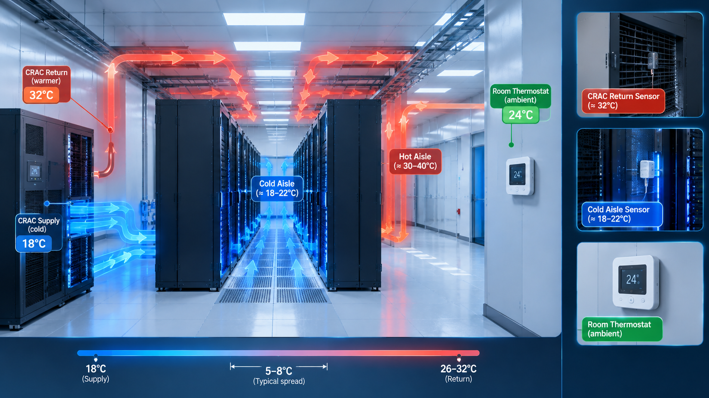
The gap cuts in both directions. A return sensor reading 5°C to 8°C above the aisle forces the unit to chase a higher number, so server room air conditioning chills the aisle below what your hardware needs. A sensor near a heat source can also read high while remote row ends stay starved. Either way, the displayed value is a proxy for compliance, not evidence of it.
Test standards make the same point from the other end. ANSI/ASHRAE 127-2007 uses a single 75°F return-air temperature for every CRAC configuration. The AHRI 1360 draft instead assigns 85°F to up-flow ducted and down-flow units, 95°F to horizontal-flow units, and 75°F to wall- and ceiling-mounted units. Change the sensing location and the rated efficiency moves with it. Every server room air conditioning rating is only as good as the point being measured.
How Containment Widens the Spread Between Supply and Return
Containment does not close the measurement gap; it widens it. Sealed hot aisles capture exhaust and return it directly to cooling units, pushing return air toward 35°C to 46°C (95°F to 115°F) while cold aisles hold near setpoint. A single room number then describes neither aisle, yet it is the number most dashboards surface first.
Two sensors in the same room can sit twenty degrees apart and both legitimately report ambient temperature. That is the trap. Operators reviewing one dashboard value conclude the space is stable, when the number simply reflects where the probe happens to sit. The instrument is not lying. Server room air conditioning that reports one number cannot describe a room with two climates.
Where Server Room Air Conditioning Quietly Stops Working: The Density Threshold
Density, not floor area, decides whether air-side server room air conditioning still controls the room. Open hot-aisle and cold-aisle layouts hold up to roughly 5 kW to 8 kW per rack. Cold-aisle containment extends that to 10 kW to 15 kW. Hot-aisle containment reaches 15 kW to 30 kW. Beyond roughly 30 kW per rack, air cooling becomes physically inadequate, and perimeter server room air conditioning must be supplemented or replaced.
Recirculation is the mechanism that breaks the pattern first. Missing blanking panels or loose cable management let exhaust air leak back into the intake zone. Documented local inlet temperatures then rise 5°C to 10°C, while the room average never registers the change upstream. By the time the panel reacts, the affected rack has run warm for weeks.
Why Free-Cooling Decisions Rest on the Same Reading
Economizer strategies depend on rack inlet conditions across the room, not on a single return reading. Temperate climates support roughly 3,000 to 5,000 free-cooling hours annually. In the UK, sites above 30 kW of IT load can run air-side or water-side economizers to hold PUE below 1.3 for six or more months each year. Server room air conditioning control needs the same inlet data to decide when outside air can take over.
The equipment farthest from the cooling unit leaves the recommended envelope first when a setpoint moves. A return-air figure will not show you that drift. Facilities that raise setpoints using return data therefore discover the failure at the rack, not at the panel, usually during a heat event. Free cooling depends on knowing which inlet is the marginal one.
The Humidity Half of the Measurement Problem
Temperature compliance can coexist with humidity non-compliance. The recommended band runs from a -9°C dew point to a 15°C dew point, capped at 60% relative humidity. Low humidity raises static discharge risk; high humidity raises condensation risk on any surface below the dew point. A temperature alarm will never announce either condition, and a dry-bulb-only server room air conditioning sensor will not either.
A room sitting comfortably inside its temperature envelope can still be out of spec on humidity. Reading temperature alone misses this entirely, and a single averaged humidity sensor carries the same blind spot as a single averaged temperature probe. Server room air conditioning that controls one variable while assuming the other is stable is only half-commissioned.
What the Uptime Institute’s PUE Survey Says About Cooling Waste
The Uptime Institute’s 2023 Global Data Center Survey reported an average PUE of 1.58 across operators. Cooling drives most of that overhead. In a conventional low-efficiency facility, cooling losses run roughly three times larger than power losses, split between the cooling plant and fan-coil systems. That ratio makes cooling the first place to look for recoverable energy.
Containment and economization close the gap quickly. The NSIDC data center moved from an annual average PUE of 2.01 on a CRAC-only system to 1.55 after adding hot-aisle containment and evaporative cooling, then below 1.35 in cool months. NREL’s Research Support Facility reached 1.16 within eleven months. Neither result needed a larger plant, only better airflow discipline and a tighter control point.
How to Move the Control Point From the CRAC Return to the Rack Inlet
- Instrument rack inlets at top-of-rack and row ends, not only the central sensor.
- Map which server room air conditioning unit serves which row before changing anything.
- Validate each setpoint against inlet data after every hardware refresh.
- Seal unused U-space with blanking panels and close cable cutouts.
- Match perforated-tile open area to the adjacent load: 25% for low density, 56% to 68% for dense rows.
- Hold under-floor pressure at 0.02 to 0.05 inches of water column.
- Commission containment before raising any setpoint.
Order matters more than any single action. Raising a setpoint before sealing bypass paths simply pushes mixing deeper into the row. The cooling unit then compensates for air that never passed through a server, and the energy saving disappears while the risk remains. Sequence the work, then measure again with the same survey method.
What Fixing the Measurement Point Actually Saves
The reliability case is blunt. Industry data cited by mechanical contractors attributes 55% of data center outages to overheating, with downtime for mission-critical operations exceeding $5,000 per minute. Sensing at the rack inlet converts that risk into a measurable alarm rather than a discovery during failure. Prevention here is a sensor placement decision.
Savings are equally concrete. Blanking panels and cable sealing typically cut cooling energy 5% to 10% immediately. Full containment reduces it 20% to 30%. Raising setpoints by 2°C to 3°C, once inlet data supports it, saves a further 4% to 6% of cooling energy per degree. Each gain is measured at the rack, not inferred from the panel that reports server room air conditioning status.
Why High Setpoints at Google Do Not Transfer to a 40 kW Comms Room
Hyperscalers run warmer rooms because software anticipates hardware failure and routes around it. That posture works when thousands of servers are available to absorb a loss. A 40 kW communications room running business-critical systems rarely has that redundancy, so its setpoint ceiling is set by consequence rather than by ambition.

Sizing rules also differ from the intuition many operators bring. Required cooling is total IT load multiplied by 1.1 for lighting and leakage, plus 5% to 10% headroom. A 10 kW cabinet therefore needs roughly 12 kW of cooling. Never size on floor area alone, because a 6 m² room can carry 40 kW of IT load and still need precision server room air conditioning.
A Field Checklist for Server Room Air Conditioning Commissioning
Commissioning should end with evidence that server room air conditioning holds the envelope at the intake, under load, at the worst-case rack. Verify sensor placement first, since every later decision inherits its error. Then confirm airflow, then containment, then setpoint. Skipping ahead produces a room that passes inspection and still runs hot.
- Record inlet temperature at three heights per rack: bottom, middle, and top.
- Log the coldest and warmest rack in each row, not the room average.
- Confirm dew point and relative humidity at the same points.
- Re-run the survey at peak load and again during the warmest outdoor week.
- Re-check after any rack swap, since density changes invalidate the last survey.
False compliance is cheaper to prevent than to discover. Move the sensor to the intake, prove the airflow path, and only then relax the setpoint. The room will still read comfortably on the panel, this time because the racks agree with it. Server room air conditioning succeeds when the number on the screen matches the air the servers actually breathe.

发表回复