


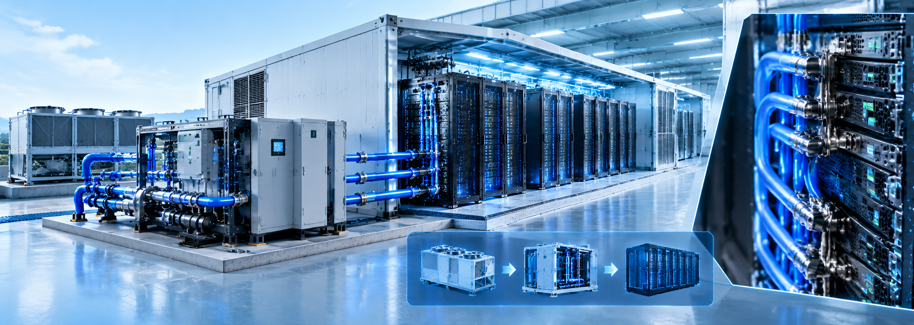
For a 100–150 kW AI rack, modular data center liquid cooling is no longer an efficiency upgrade but a capacity requirement. Above roughly 50 kW per rack, air cannot move enough heat, and a current NVIDIA GB200 NVL72 rack draws 120–132 kW with liquid cooling built in by design. The single decision that determines success is matching the coolant distribution unit, the two-loop plumbing, and the residual air handling as one engineered system rather than buying a CDU by nameplate kilowatts alone.
What does modular data center liquid cooling mean for a 100 kW rack?
A modular data center liquid cooling build uses factory-prefabricated enclosures or skids in which the cooling plant is integrated before delivery. The University of Göttingen took this route for its Emmy supercomputer: STULZ delivered a four-room modular facility in under two months, housing 1.5 MW of compute at roughly 100 kW per rack. The project captured 78 percent of heat through liquid and 22 percent through air.
That deployment demonstrates the core architecture. Cold plates mount directly on GPUs, CPUs, and switch chips. A treated technology cooling loop carries heat to a CDU. Inside the CDU, a heat exchanger transfers that energy to a separate facility water loop, which rejects it through dry coolers, a tower, or a chiller. The two loops never mix, and that isolation is the point of the entire design.
Modular data center liquid cooling crossed into the mainstream in 2025. Data Center Dynamics reported that Google had enabled or deployed liquid cooling across about half of its global footprint, roughly 1 GW across 2,000 TPU pods, while achieving 99.999 percent uptime. The Uptime Institute’s 2025 cooling survey found about one in five operators already using direct liquid cooling, with most others evaluating it.
How much of a 120 kW rack actually enters the liquid loop?
Cold plates do not capture every watt. For current GPU nodes, vendors put liquid capture between 60 and 90 percent, with 75 to 85 percent the realistic planning band. Vertiv quotes 70 to 75 percent to liquid. The remainder leaves through power supplies, memory, NICs, and drives into the room air.
Apply that to a flagship rack. NVIDIA specifies the GB200 NVL72 at about 120 to 132 kW, with its reference loop running 25 °C supply and 45 °C return. Even at the top of the capture range, more than 25 kW still enters the room. A modular data center liquid cooling design that omits that air-side load will overheat the hall even when the chip loop is healthy.
The flow arithmetic is equally fixed. At a 10 K temperature rise, a liquid rack needs roughly 1.5 liters per minute per kilowatt. A 100 kW rack therefore needs around 150 L/min, and NVIDIA’s published figure for the NVL72 is approximately 2 liters per second. Pipe diameter, pump head, and manifold sizing for modular data center liquid cooling all derive from these numbers, not from a generic catalog rating.
How do you size a CDU without undersizing the loop?
Undersizing is the most common deployment error, and it produces an obvious symptom: coolant temperature climbs, GPUs throttle, and training throughput falls. The CDU must handle the peak liquid-side heat load, not the total rack nameplate. The calculation is total rack power multiplied by the expected liquid capture ratio.
This is the liquid-side baseline every modular data center liquid cooling row must meet. A row of ten racks at 100 kW each at a 0.75 capture factor gives 10 × 100 × 0.75, or 750 kW. Production clusters above 500 kW then require N+1 CDU capacity with cross-tied manifolds, because a CDU outage can take a row offline within 60 to 120 seconds. Both units should feed both halves of the row through valved tie-ins.
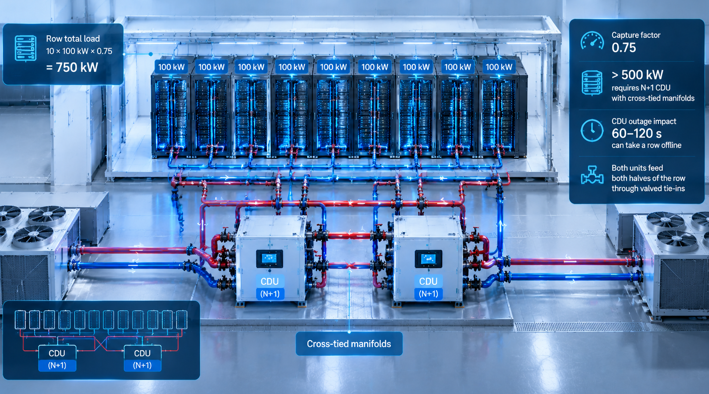
Capacity is only one variable in a modular data center liquid cooling plant. The CDU must also be specified for flow rate, pressure drop across long manifolds, filtration, and approach temperature. The approach is the gap between cold facility water and warm secondary supply; a CDU cannot deliver coolant colder than facility water plus that gap. Selecting a modular data center liquid cooling unit on kilowatts alone is why some builds work in winter and throttle in summer.
CDU capacity scaled sharply in 2025 as rack power rose. Data Center Dynamics tracked 2 MW units becoming normal, with Schneider Electric and Motivair announcing a 2.5 MW CDU and Flex and JetCool demonstrating a modular solution stitchable to 1.8 MW. These larger units let a prefabricated modular data center liquid cooling plant match the megawatt-class rows that AI now demands.
Which ASHRAE water class should the facility loop target?
Selecting water temperature is the decision that shapes the entire modular data center liquid cooling plant. ASHRAE defines facility water classes by maximum supply temperature, from W17 through W45 and W+ above 45 °C. The lower classes imply mechanical chillers. W27 suits standard direct-to-chip deployments, W32 fits optimized AI cold plates on towers or dry coolers, and W40 and above can run almost year-round on dry cooling in temperate climates.
Most current systems accept W32 to W45. The counterintuitive goal is to run the loop as warm as the cold plates allow. A 35 °C supply can still keep silicon below its junction limit while letting heat reject through rooftop dry coolers, bypassing the chiller for most operating hours. This is where modular data center liquid cooling earns its energy advantage, by deleting the largest non-IT load.
The facility water temperature in any modular data center liquid cooling design must be chosen early and jointly with the IT vendor. It decides whether the roof carries chillers or dry coolers, the size of the pipework, and the building’s energy balance. It also decides heat reuse: W45 and above is the band where waste heat becomes genuinely useful to a district network rather than a marketing claim.
Climate changes the sizing margin. A dry cooler must be specified against peak ambient, not annual average. When summer heat pushes facility water up, the secondary loop rises with it and GPUs throttle. Heat rejection capacity sized for peak conditions separates a system that runs all year from one that only runs from October to March.
Why is the residual air-side load the most common design miss?
Every modular data center liquid cooling hall is a hybrid hall. Schneider Electric emphasized that the foreseeable design always combines air and liquid components, because memory, drives, power supplies, and network switches still reject heat to the room. The Göttingen build reserved a second, air-cooled module specifically for network and storage equipment.
The practical failure is planning for liquid while ignoring the 15 to 25 kW of room heat per rack. Rear-door heat exchangers on the same secondary loop are a common answer, capturing residual chassis air before it enters the hall. Door capacity varies strongly with water temperature, and supply water must stay above the dew point to avoid condensation.
Workload segregation matters on a shared loop. Running 1,000 W GPU racks and low-density storage on the same secondary circuit forces a temperature compromise that wastes free-cooling headroom. A disciplined modular data center liquid cooling layout groups racks by thermal class and gives each class a loop tuned to its needs.
What does commissioning a modular data center liquid cooling plant require?
Most first-year failures in modular data center liquid cooling are loop failures, not silicon failures. Pressure-test the entire secondary loop at 1.5 times working pressure for at least 24 hours before any IT equipment lands. Pull a coolant sample, run a chemistry panel, and confirm filtration before flow begins. A complete P&ID, valve list, and isolation procedure must be handed to the in-house operations team.
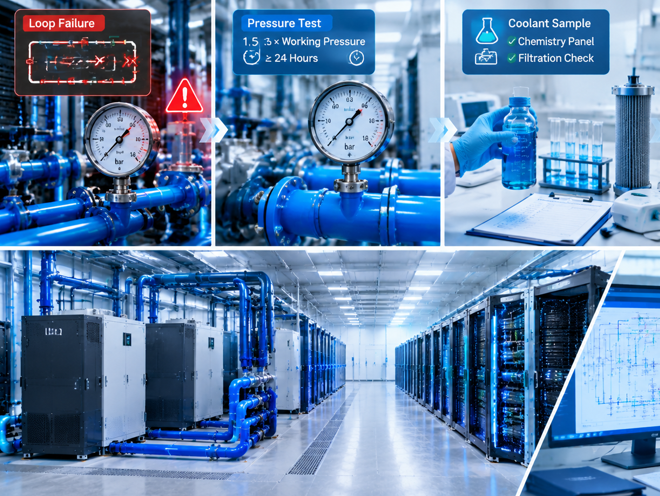
Coolant chemistry is a permanent maintenance item for modular data center liquid cooling. A water-glycol secondary loop targets pH of 8.0 to 9.5 and conductivity below 50 microsiemens per centimeter, while deionized loops are held far lower, often below 5 to 10. Out-of-spec fluid corrodes cold plates, seeds biofilm, and gradually clogs the microchannels that make direct-to-chip cooling work. Monthly testing and quarterly top-ups are standard.
Leak defense is built, not assumed. Install detection ropes under every rack and manifold, around every CDU, and beneath any raised floor, with automatic pump shutdown on detection. Blind-mate quick disconnects are the most likely service failure point, and the most common first-year incident is a manifold drain valve left mispositioned after commissioning. Positive valve line-up confirmation prevents it.
Air ingress is the quieter fault. Any air in the secondary loop cuts local cold-plate heat transfer sharply and invites pump cavitation. Automatic air separators on the CDU, slow fill procedures, and venting at high points keep the loop full. These commissioning steps are where you earn the reliability that makes a dense cluster safe to operate.
What structural and redundancy risks do operators overlook?
A fully loaded liquid-cooled rack with an in-rack CDU can weigh 1,400 to 1,800 kg. JLL puts floor loading for high-density liquid equipment at 20 kPa or more, against the 12 to 15 kPa that conventional halls were designed for. In a retrofit this can decide the project, and slab loading must be verified at design time, not after racks arrive.
Retrofits of modular data center liquid cooling also face a heat-rejection gap. A facility moving from 8 kW air-cooled racks toward 80 kW liquid-cooled racks can need three to five times the cooling plant capacity, often the largest capital item in the project. A 1 MW deployment typically requires six-inch supply and return mains routed to each CDU, infrastructure that simply does not exist in an air-cooled hall.
Redundancy follows the new critical path in modular data center liquid cooling. Pumps and CDUs need the same N+1 treatment as the fans they replace, with isolation valves allowing service without draining a row. As rack power rises toward the 600 kW figures now on vendor roadmaps, these structural, electrical, and hydraulic constraints tighten together rather than separately.
Final checklist before you deploy
A modular data center liquid cooling project passes or fails on integration. Confirm the exact rack model and peak power, multiply by a realistic 0.75 to 0.85 capture factor to size the CDU, and add N+1 units with cross-tied manifolds. Choose the ASHRAE water class before the building is laid out, size dry coolers for peak ambient, and design for the residual air-side heat that every rack still produces.
Then verify the unglamorous items: floor loading, pipe diameters, coolant chemistry, leak detection, and a 24-hour pressure test. Done together, these modular data center liquid cooling steps deliver what Göttingen showed was possible, dense AI capacity deployed in weeks rather than months, at an annual PUE near 1.1 instead of the air-cooled average of 1.5 or higher.

发表回复