


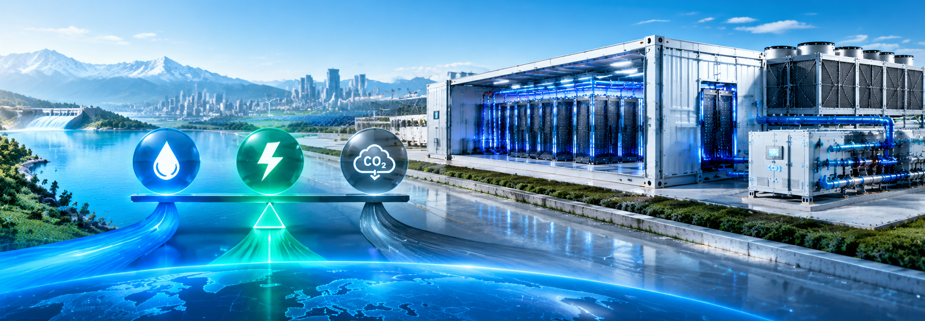
Cloud data center liquid cooling does not automatically save water, and the assumption that a lower WUE is always greener is wrong. Liquid simply moves heat to a loop; how that loop rejects heat decides the result. Evaporative towers cut electricity but withdraw water, while dry coolers drive water use toward zero at the cost of extra fan energy and carbon. The correct design is site-specific, based on which resource, water, power, or permits, is genuinely scarce.
Why Does Cloud Data Center Liquid Cooling Create a Water-Energy Trade-off?
The trade-off begins with thermodynamics rather than vendor choice. A cooling tower uses the latent heat of evaporation, so a small amount of water rejects a large heat load with little electricity. A dry cooler instead pushes ambient air across a finned coil, using no water but spending fan and pump energy. Liquid cooling only changes how heat leaves the chip; it does not remove the need to reject that heat to the atmosphere.
This is why two metrics can move against each other. Adding evaporation typically lowers compressor and chiller energy, improving PUE while raising WUE. Switching to an all-dry system lowers water use but can worsen PUE in hot weather. Industry glossaries put evaporative towers near 1.8 liters per kilowatt-hour against near-zero for dry coolers, with the explicit caveat that dry rejection carries a slightly higher energy penalty.
Cloud data center liquid cooling therefore cannot be optimized by chasing one number, and this is the mistake most enterprise RFPs make. A system tuned to the lowest possible WUE may burn more electricity, and a system tuned to the lowest PUE may withdraw millions of liters in a drought zone. The engineering task is to identify the binding constraint at each site and accept the deliberate exchange rather than pretend the constraint does not exist.
What Do the 2024 Hyperscaler WUE Numbers Actually Reveal?
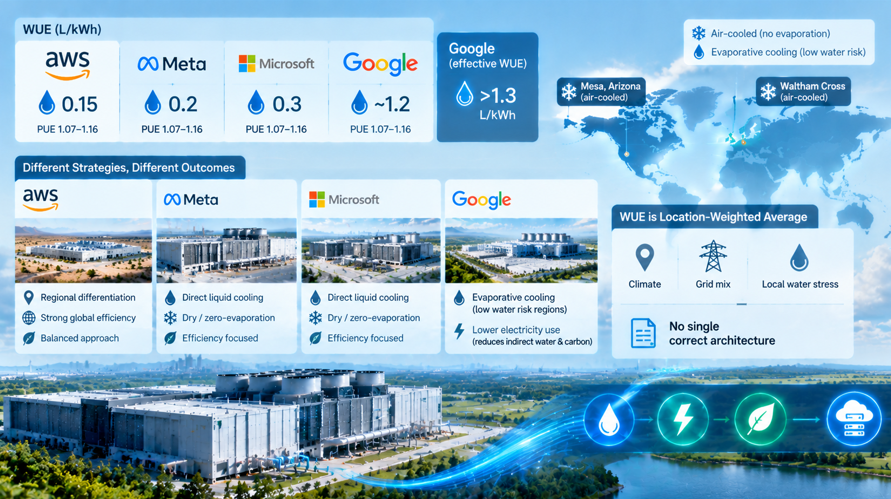
The four largest cloud operators report materially different outcomes, which proves there is no single correct architecture. Goldman Sachs, drawing on company disclosures, lists FY2024 WUE at roughly 0.15 liters per kilowatt-hour for AWS, 0.2 for Meta, 0.3 for Microsoft, and about 1.2 for Google, even though all four operate at similar PUE between roughly 1.07 and 1.16.
That spread reflects strategy, not incompetence. Meta and Microsoft favor direct liquid cooling coupled with dry or zero-evaporation rejection, while AWS uses regional differentiation and reports strong global efficiency. Google deliberately keeps evaporative cooling in low water-risk regions, arguing that lower electricity use reduces both grid carbon and the indirect water embedded in power generation.
Google’s position is the most counterintuitive in cloud data center liquid cooling. A Barclays analysis of its disclosures estimated effective WUE above roughly 1.3 liters per kilowatt-hour, yet Google says the saved electricity lowers indirect water and emissions. It does abandon evaporation in high-stress sites such as Mesa, Arizona, and Waltham Cross in the United Kingdom, using air-cooled designs there instead.
The lesson for cloud data center liquid cooling is that a published WUE number is a location-weighted average, not a universal scorecard. Comparing providers on WUE alone, without climate, grid mix, and local water stress, rewards one architectural choice while hiding its energy cost and the reason each operator chose it.
How Much Water Does Evaporative Rejection Really Consume?
Most questioned water use in cloud data center liquid cooling comes from evaporation, not from the liquid loop itself. U.S. Department of Energy data, reported by trade press, shows direct cooling withdrawals at U.S. data centers rising from about 21 billion liters in 2014 to roughly 66 billion in 2023, with projections of 145 to 275 billion a year by 2028 if capacity keeps expanding.
Direct withdrawal is only part of the footprint. Thermal power plants that supply the data center also need cooling water. Reports citing the Department of Energy note that for roughly 176 terawatt-hours of U.S. data center power in 2023, the associated indirect water use approached 800 billion liters. Meta disclosed that its purchased electricity embedded over 72 billion liters of indirect water against only 5.6 billion withdrawn on site.
This indirect layer is central to the Google argument for cloud data center liquid cooling. If evaporative towers save electricity, they also reduce water consumed upstream at power plants. Coal plants can withdraw around 70 liters per kilowatt-hour, while wind and solar photovoltaic use almost none, so the value of saved electricity depends heavily on how the local grid is generated.
The implication for cloud data center liquid cooling is that water accounting must span the full boundary. A site WUE near zero can still carry a large indirect water burden if its extra fan and chiller load is served by water-intensive thermal generation, which is precisely why on-site liters alone are misleading.
When Does a Dry Cooler Save Water Without Burning Carbon?
Dry rejection in cloud data center liquid cooling works best where ambient air is cool, because the coil must stay above ambient by a finite approach, often 8 to 15 degrees. In cold or temperate climates, a warm-water loop at 40 to 45 degrees can run on dry coolers for thousands of hours a year with minimal evaporation and little energy penalty. In hot climates, capacity falls as temperature rises.
Operators in hot regions add adiabatic assist, hybrid units, or backup chillers for the hottest peaks, which reintroduces water or compressor energy exactly when the system is stressed. A fully dry design in a desert climate can require oversized coils and far more fan power, pushing PUE upward during summer peaks rather than holding it flat.
Cloud data center liquid cooling is therefore most defensible when the dry-cooler window matches local weather data rather than a vendor headline. The decision should compare annual hours in dry mode, peak-day energy, and the carbon intensity of the marginal grid supply at that peak, not just the annual average WUE.
Where the grid is already decarbonized and the climate is cool, dry rejection is close to a free win for cloud data center liquid cooling. Where the grid is carbon-intensive and the climate is hot, forcing zero evaporation can trade a visible local water problem for an invisible upstream emissions problem.
How Should a Cloud Operator Choose Between Dry, Evaporative, and Hybrid Loops?
The disciplined method for cloud data center liquid cooling starts from local scarcity, not a corporate standard. In water-stressed regions with permitting pressure, a dry or near-dry loop protects the license to operate even at a modest energy cost. In regions with abundant water and a dirty grid, well-managed evaporative rejection can lower both electricity and total indirect water.
Hybrid units formalize the compromise. They run dry for most hours and use evaporation only on the hottest days, capturing a large share of water savings while avoiding the worst peak-day fan energy. This staged approach fits cloud data center liquid cooling because the operating set point can shift with weather rather than being fixed to one architecture.
Three inputs drive the choice. The first is local water stress and the cost or availability of supply. The second is electricity price and grid carbon intensity, including the marginal generator during heat peaks. The third is regulatory and community risk, since water has become a primary focus of opposition to new campuses.
A useful test in cloud data center liquid cooling is to model the same heat load under each architecture and report both PUE and WUE, plus total carbon, across a full weather year. The design that wins on that combined metric, rather than on a single vendor headline, is the one that should be built.
Can Waste Heat Reuse Tip the Balance Toward Liquid?
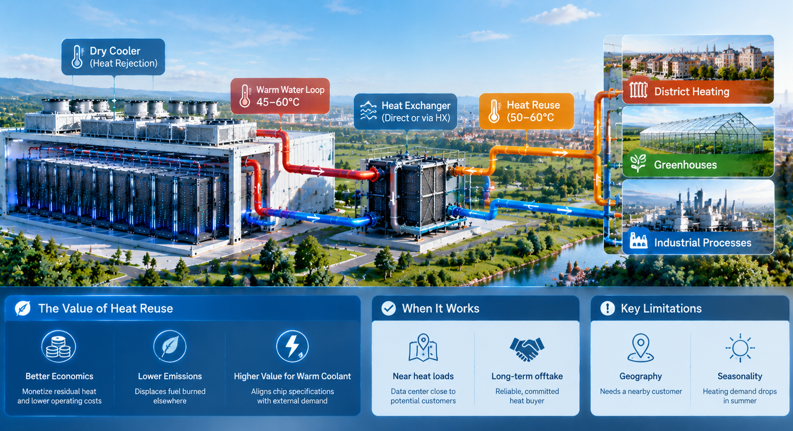
Warm-water liquid loops produce outlet coolant at 45 to 60 degrees, hot enough to feed district heating, greenhouses, or industrial processes without a heat pump in favorable cases. When that heat is reused rather than dumped, both the economics and the resource argument change, because energy that would otherwise be wasted displaces fuel burned elsewhere.
This strengthens the case for cloud data center liquid cooling near heat loads. A campus feeding a district heating network monetizes residual heat and lowers the carbon intensity of the surrounding system, partially offsetting the energy spent in dry rejection. It also raises the value of warmer coolant, aligning chip specifications with a useful external demand.
The limitation is geography and season. Heat reuse requires a nearby customer willing to sign a long-term offtake, and heating demand falls sharply in summer. Without that anchor customer, reuse stays theoretical. It should be treated as a structured upside in cloud data center liquid cooling, not assumed inside the base efficiency case.
What Should the Acceptance and Reporting Standard Include?
Reporting should match the complexity of the trade-off rather than hide it. Publishing a single blended WUE conceals the climate and grid differences that drive the result. A clearer standard reports site-level PUE and WUE, local water stress, grid carbon intensity, and the share of heat rejected through dry, hybrid, and evaporative modes.
Acceptance testing for cloud data center liquid cooling should verify the full loop under a realistic peak load, including supply and return temperatures, flow, pressure drop, CDU power, and the achieved dry-mode hours. A forced switch between dry and evaporative modes confirms hybrid controls behave as designed during heat extremes.
Indirect water and embedded carbon should be disclosed alongside on-site withdrawal for every cloud data center liquid cooling deployment. That closes the reporting gap between a low headline WUE number and the much larger upstream footprint, and lets enterprise buyers evaluate providers on total resource impact rather than marketing averages.
Is Zero-WUE Liquid Cooling the Wrong Target for Cloud Data Centers?
Zero water is a legitimate target in some locations and a misleading universal goal. The hyperscaler divergence, AWS and Meta near 0.2 liters per kilowatt-hour against Google near 1.2, is evidence that skilled engineers reach different answers when climate and grid differ. Forcing every facility to zero evaporation would raise energy use where evaporation is the more efficient path.
The better target is resilience of the total system. Cloud data center liquid cooling should match rejection architecture to local water stress, grid carbon, and permitting risk, use hybrid modes to cover peaks, and disclose the full water and carbon boundary. If you optimize WUE in isolation, you may save liters while quietly buying more coal-fired electricity.
The honest conclusion is that there is no free heat rejection, only a choice of which resource to spend: water, electricity, or the carbon embedded in both. Done transparently against local climate and grid data, that choice turns cloud data center liquid cooling from a sustainability slogan into a defensible, site-level engineering decision.
发表回复