


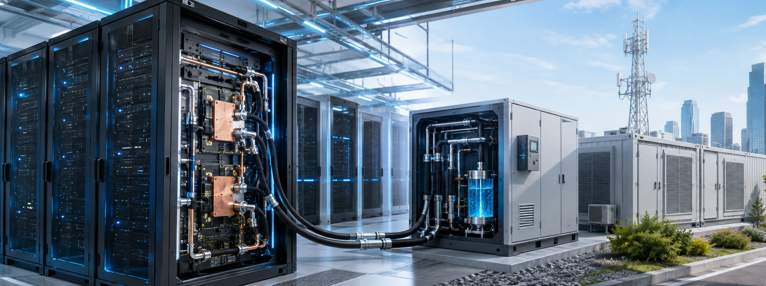
An edge computing data center that hosts AI inference now runs racks drawing 15–40 kW or more, and air cooling cannot remove that heat above roughly 30 kW per rack. The switch point is not a fixed number: it depends on rack density, electricity price, and the cramped footprint that defines edge sites. This article explains why inference is moving to the edge, where the air ceiling sits, how to compute the threshold for any edge computing data center, and what to verify before hardware ships.
Why Is AI Inference Moving into the Edge Computing Data Center?
AI inference prefers proximity. Unlike training, which tolerates centralized clusters, inference serves real-time decisions for autonomous systems, retail, and industrial control, where latency above a few milliseconds is unacceptable. The Uptime Institute defines edge facilities as smaller data centers positioned close to end users, cutting round-trip latency from the 20-to-50-millisecond range of distant hyperscale into single-digit milliseconds.
McKinsey projects inference will account for roughly 70 percent of AI compute by 2027, growing at a 35 percent CAGR to more than 90 GW by 2030. Industry projections confirm the direction: the edge AI market is forecast to grow from US$20.78 billion in 2024 to US$66.47 billion by 2030, a shift that lands these workloads in distributed sites rather than giant campuses. The result is that the edge computing data center, once a small aggregation node, is now expected to run dense accelerator racks.
How Fast Is Rack Density Rising Inside the Edge Computing Data Center?
The density curve is steep. Average rack power density demanded was about 8 kW in 2020 and roughly doubled to 17 kW by 2024, while edge and regional facilities can now support 15–40 kW racks for real-time AI inference. The Uptime Institute 2026 survey recorded a modal rack density of 27 kW, a 69 percent jump from 16 kW in 2025, with projections of 45–100 kW by 2027.
For an edge computing data center, this matters because floor space is small and power is fixed. A node designed for 10 kW racks cannot absorb a 30 kW inference rack without reworking cooling, power feeds, and structural loading. That gap, between what edge sites were built for and what inference hardware demands, is why the cooling decision has become urgent for every edge computing data center operator.
Why Does Air Cooling Hit a Wall Near 30 kW per Rack?
Air is a weak heat-transfer medium. A 2026 study in the journal Energy and Buildings found that air-cooled facilities with row-based cooling support rack densities up to about 29.5 kW. Beyond that, fans cannot move enough air to keep silicon within thermal limits, and hardware throttles.
Industry sources, including the Uptime Institute, put the practical air ceiling between 20 and 35 kW per rack. ASHRAE Technical Committee 9.9, which sets thermal guidelines, has added a Class H1 band for high-density systems and recommends direct-to-chip cooling above roughly 20 kW per rack, an explicit admission that air-first design no longer matches the hardware. For an edge computing data center, the ceiling arrives faster than in a hyperscale hall because there is less room to add airflow and containment, and because every extra fan pushes the node past its power budget.
The table below compares air and direct-to-chip cooling on the metrics that actually drive an edge computing data center decision: maximum rack power, chip-level thermal design power, cooling energy share, achievable PUE, and waste-heat temperature.
The figures come from the Energy and Buildings study, ASHRAE TC 9.9, and operator-reported data collected in 2025–2026. Two findings stand out. First, air supports roughly one-third to one-quarter of the power that direct-to-chip handles in the same footprint. Second, the PUE gap, 1.5–2.0 versus 1.03–1.20, is the recurring energy cost that dominates total cost of ownership over a ten-year life, which is the horizon most edge infrastructure contracts actually use.
| Metric | Air Cooling | Direct-to-Chip Liquid Cooling |
|---|
| Max practical rack power | 20–35 kW | 60–120+ kW |
| Chip TDP supported | 200–350 W | 700–1,200+ W |
| Cooling share of total energy | 38–40% | 4–8% |
| Typical PUE | 1.5–2.0 | 1.03–1.20 |
| Heat-reuse temperature | 30–40°C (hard) | 60–75°C+ (excellent) |
At What Density Should an Edge Computing Data Center Switch to Direct-to-Chip Cooling?
The threshold is an economic inflection point, not just a thermal one. At an electricity price of $0.12/kWh, direct-to-chip cooling beats air on ten-year total cost of ownership once racks pass roughly 30 kW, because a 40 percent PUE improvement and a 17 percent throughput gain from eliminating throttling recover the higher capital cost within about three years.
At $0.15/kWh, common in parts of North America and Europe, the inflection drops to about 24 kW per rack. In an edge computing data center, these thresholds arrive at lower absolute power than in a hyperscale hall because there is no economy of scale to absorb cooling overhead. If planned racks sit above 24–30 kW, liquid cooling should be designed in from day one rather than retrofitted later, because the upgrade window at a small edge site is much shorter and site outages are harder to schedule.
What Cooling Options Fit an Edge Computing Data Center?
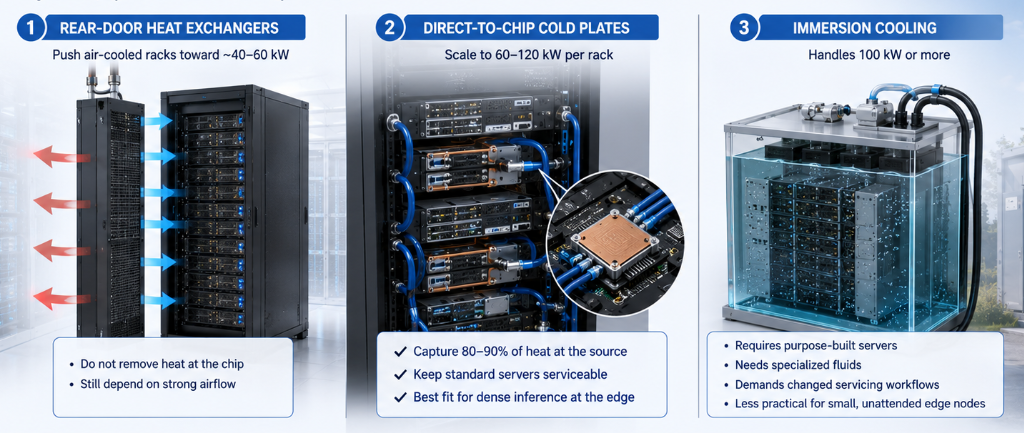
Beyond air, operators have three liquid routes: rear-door heat exchangers, direct-to-chip cold plates, and immersion. Rear-door units push air-cooled racks toward roughly 40–60 kW, but they do not remove heat at the chip and still depend on strong airflow. Immersion handles 100 kW or more, yet it demands purpose-built servers, specialized fluids, and changed servicing workflows, all of which sit awkwardly in a small, unattended edge node.
Direct-to-chip cold plates capture 80–90 percent of heat where it is generated, keep standard servers serviceable, and scale to 60–120 kW per rack, which is why an edge computing data center planning for inference density usually lands on this option first.
What Makes Liquid Cooling a Better Fit for the Edge Computing Data Center?
The edge computing data center operates under constraints that hyperscale never faces: no full-time engineers, tiny physical footprint, and strict power budgets. Direct-to-chip cooling fits because it removes heat at the source, capturing 80–90 percent of server heat and cutting cooling energy from roughly 40 percent of total power to 4–8 percent. Facilities built with direct-to-chip reach PUE values of 1.03–1.20 instead of the global average of about 1.54 in the Uptime Institute’s 2025 survey.
Warm coolant return at 35–50°C enables free cooling and waste-heat reuse at remote sites. Leak-tight quick disconnects and manifold design allow rack swaps without draining loops, and lower fan noise makes an edge computing data center acceptable in urban buildings where a loud data hall would not be. Direct-to-chip now holds about 55 percent of the liquid-cooling market, the mainstream answer for dense racks.
What Must Be Checked Before Retrofitting an Edge Site for Liquid Cooling?
Retrofitting is riskier than designing fresh, and four checks decide whether an existing edge node can accept direct-to-chip cooling.
First, confirm structural capacity: a dense AI rack can exceed 1,500 kg with point loads near 1,800 kg per square meter, while many legacy floors are rated for only 2,000–2,500 lb.
Second, verify facility water or chilled-water capacity in tons at worst-case outdoor conditions, because every kilowatt into a rack returns as heat.
Third, confirm power delivery, since racks drawing 40 kW or more can exceed feeder and UPS headroom sized for 10 kW. Fourth, plan leak detection and CDU placement, and commission the loop under load before any accelerator ships. In an edge computing data center, each of these checks can be performed remotely, which suits sites with no resident engineer.
What Is the Practical Decision Path for an Edge Computing Data Center?
Follow this sequence before signing a design. Confirm the manufacturer’s rack power and heat specification, not a rule of thumb. Map usable power headroom on feeders, UPS, and generator, not nameplate figures. Run the cost-inflection calculation using your local electricity tariff. Decide between air, hybrid, and direct-to-chip by comparing ten-year total cost of ownership.
Then verify floor, water, and leak-detection readiness and sign a per-zone readiness gate before GPUs ship. This ordering matters because each step validates or invalidates the next, and skipping the power audit is how edge projects stall after hardware arrives. Applied consistently, the same checklist scales across a fleet of dozens of edge computing data center sites, turning each retrofit decision into a repeatable, auditable process.
For an edge computing data center, the cooling question is no longer optional engineering detail. As inference racks climb past 24–30 kW, air cooling fails both physically and economically, and direct-to-chip liquid cooling becomes the lowest-cost, most reliable option within about three years of operation.
The decision window is short: verify power, floor, and water capacity early, size cooling for measured peak demand, and plan for liquid wherever densities will climb. An edge computing data center that treats cooling as a first-class design input can host AI inference with single-digit-millisecond latency, lower energy cost, and a PUE near 1.1. Operators who ignore the threshold will throttle silicon, stall deployments, and pay for retrofits at roughly twice the upfront cost, while competitors capture the same inference market with a design that was ready from day one.
发表回复